

For this edition of Classic Steel, we are going to take a look back at Kawasaki’s revamped KX250 for 1989.
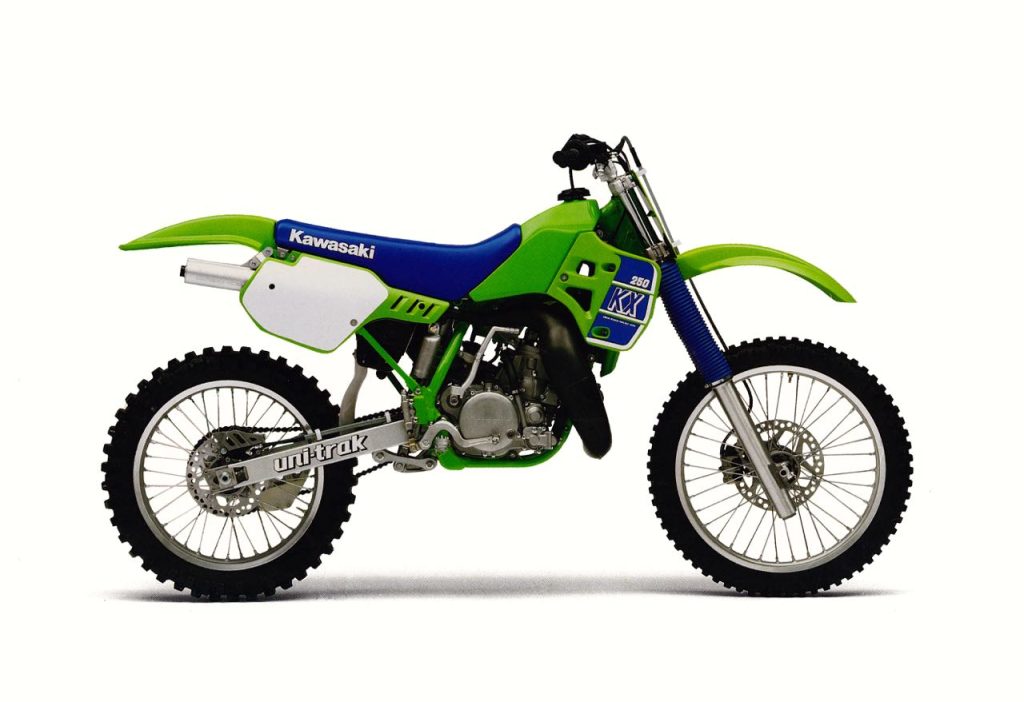 Slimmer, strimmer, and more polished, Kawasaki’s KX250 was one of the best machines in the class in 1989. Photo Credit: Kawasaki
In 1988, Kawasaki’s all-new KX250 was one of the most potent machines on the track. Its advanced KIPS-equipped motor was an absolute rocket with gobs of low-end torque and a tire-shredding midrange blast. Experienced riders loved its potent powerband and compared its monstrous hit to that of an Open bike. In any contest of outright speed, it romped on the competition and left its red, yellow, and white competitors eating roost and sucking two-stroke smoke.
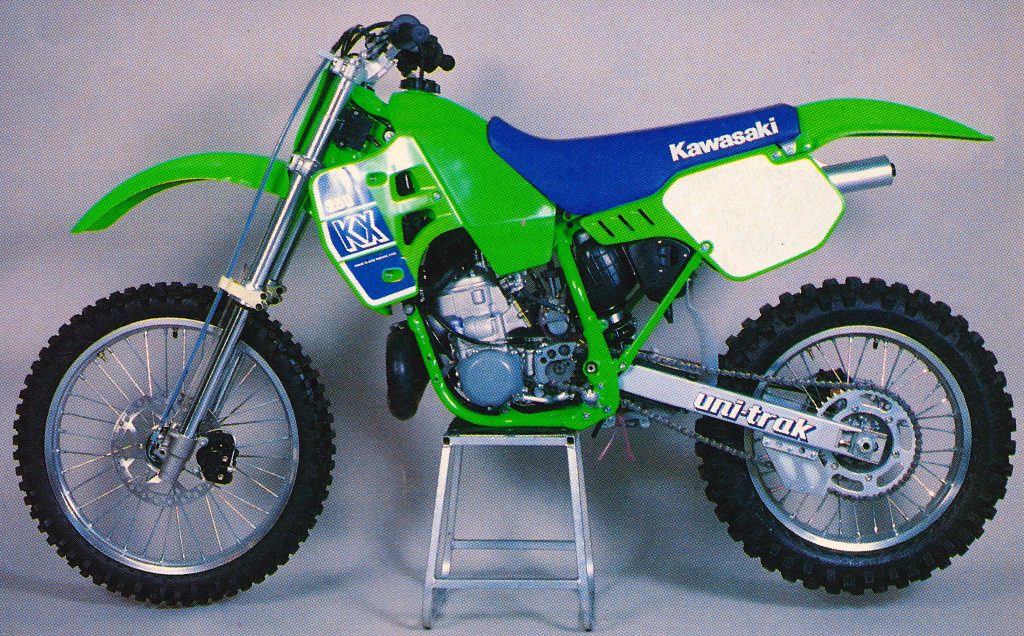 Early press photos for the ’89 KXs had the machines sporting Kayaba’s all-new 41mm inverted cartridge forks. While other markets stuck with the inverted forks, Kawasaki USA’s testers felt they needed additional development and pushed the Japanese to hold off on the switch for one more season. Photo Credit: Kawasaki.
With its potent motor, the green machine had many fans in 1988, but motocross is about much more than just trench-digging horsepower. In 1987, the KX250 had been the slimmest machine on the track with a razor-thin layout that riders loved. For 1988, however, Kawasaki updated the KX with all-new bodywork that took its feel from slim and trim to plump and portly. The tank was tall and wide, the bodywork was thick, and the seat was a giant sack of Jet-Puffed marshmallow cream. In addition to running and feeling like a 500, the all-new KX missed the mark with its drag-prone front disc, brittle plastic, leaking gas cap, and poorly damped rear shock. Overall, it was a fun machine to ride and super-fast, but most testers preferred the less thrilling but more well-rounded YZ and RM to the big, bad, and burly KX in 1988.
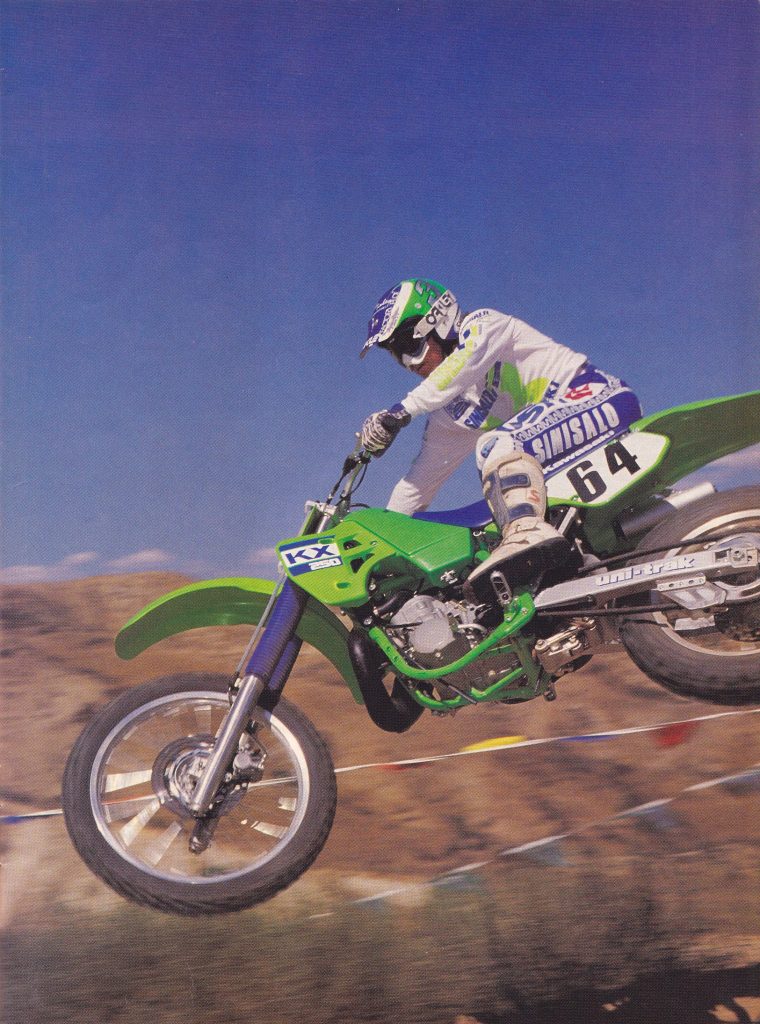 In 1988, the KX250 was the rocket of the class, but its pudgy layout and massive hit made it feel more like a 500 than a lithe 250. For 1989, Kawasaki aimed to make the big green meanie a bit more user-friendly with a smoother motor and slimmed-down ergonomics. Photo Credit: Motocross Action
For 1989, Kawasaki looked to capitalize on the things riders loved about the ’88 KX while smoothing out a few of its rough edges. In the ’88 redesign, the KX250 picked up 10 pounds of weight, and every one of those pounds was apparent on the track. It handled well, but felt big, heavy, and unwieldy. Knowing this was an issue for many, Kawasaki dialed up several changes aimed at minimizing the KX’s girthy feel.
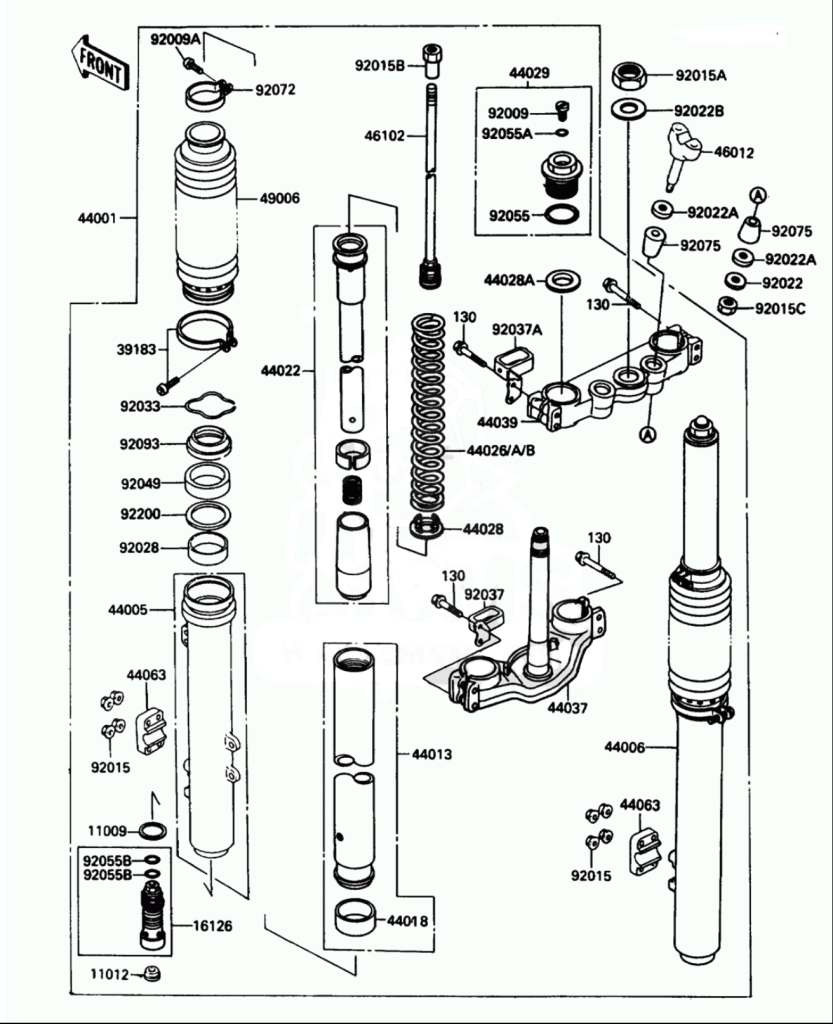 Kawasaki USA decided to pass on the inverted forks for 1989 and instead went with a version of the conventional Kayaba forks raced by the factory team in 1988. The new forks added 3mm to the diameter of the stanchions to reduce flex while still maintaining the favorable comfort characteristics of the conventional design. Photo Credit: Kawasaki
First up was an all-new tank that reduced the fuel capacity by 0.4 gallons. The new fuel cell featured slimmer lines at the seat/tank juncture and a considerably lower profile. A new seat was also added with a taller and flatter profile and much denser foam than the year before. This made it easier to slide forward in the turns and gave the machine a noticeably trimmer feel. The design of the rest of the KX’s bodywork remained unchanged from the year before, but Kawasaki did reformulate the plastic for 1989 to be less brittle than in the past. In some markets outside the US, the side plates were swapped to a deep blue in 1989, but US-bound bikes retained the green of previous seasons.
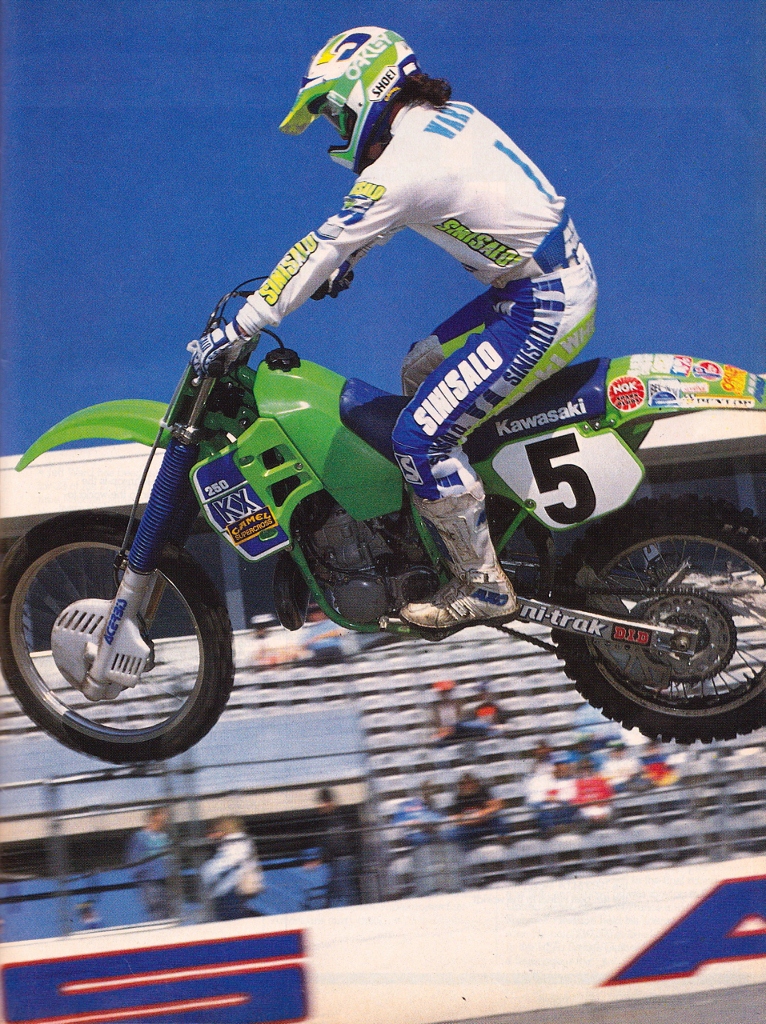 Jeff Ward was Kawasaki’s top gun on the KX250 in 1989. Jeff was fast in Supercross, winning four events, but an early-season injury would prevent him from claiming his third AMA Supercross title. Photo Credit: Motocross Action
In addition to nipping and tucking some of the bodywork, Kawasaki looked to spice up the KX’s handling by lowering the bike’s weight and steepening up its geometry for 1989. The frame looked very similar to that of 1988, but the main frame tubes were decreased in diameter by 0.2mm to save weight, and the alloy subframe was painted green to match the rest of the machine. The revamped frame reduced the head angle from 28 degrees to 27 degrees to improve cornering response. An all-new alloy steering stem saved a few ounces, and all-new lighter hubs further reduced the KX’s profile on the scale. All-new brakes for 1989 saved additional weight by moving from cast iron to stainless steel for their construction. The revamped rotors were 3mm thicker than in 1988 and featured 1.5mm thicker pads for improved durability. An all-new dual-piston caliper in the front promised improved feel and an end to the annoying and occasionally dangerous dragging from the single-piston unit used in 1988. In addition to the new hubs, Kawasaki also moved to a 19” hoop in the rear for 1989. This was another trick of the factory teams who found the lower profile rear tire to provide better traction on hard and slick surfaces. All told, the chassis improvements and updates for 1989 added up to a 4.5-pound weight savings over the ’88 machine.
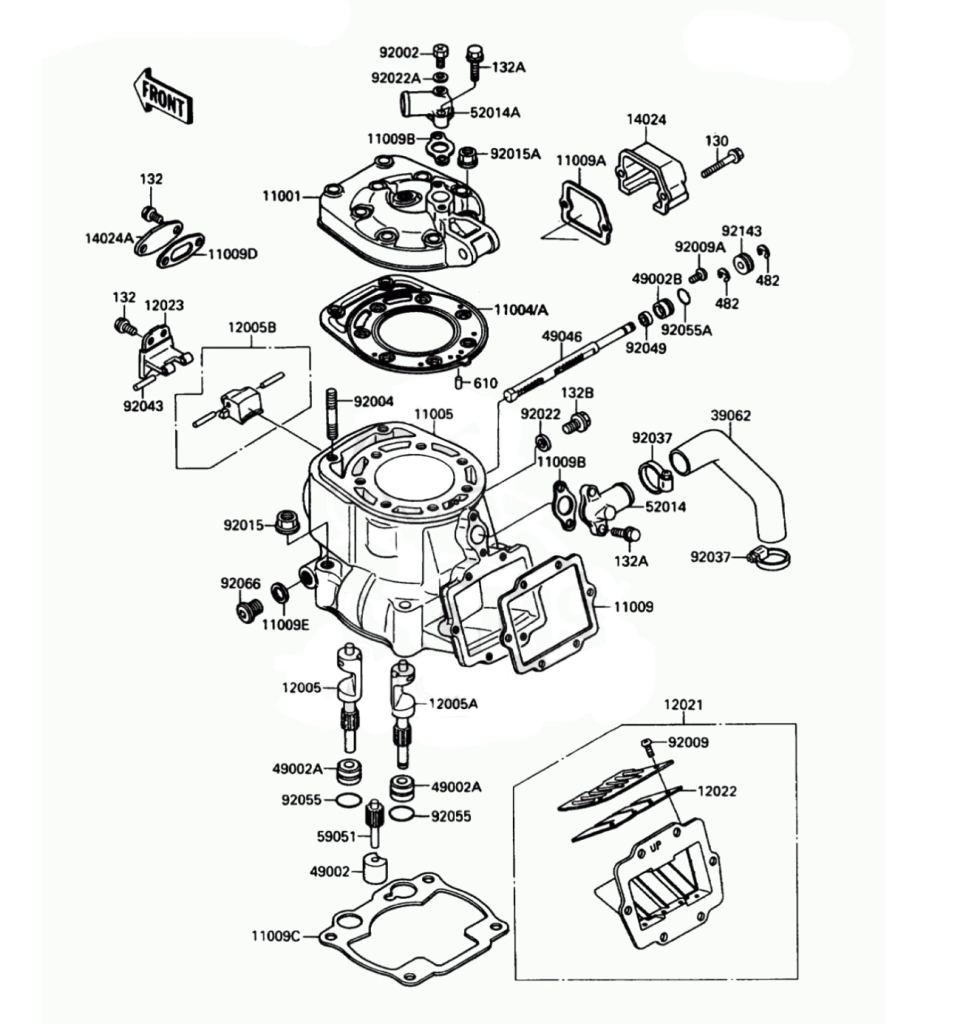 For 1989, Kawasaki reconfigured the porting and adjusted the KIPS on their 249cc powerhouse to broaden the power and smooth out the ’88 motor’s explosive delivery. Photo Credit: Kawasaki
On the suspension front, the KX250 had a very interesting story to tell in 1989. Initially, all the full-size KX models were set to come with Kayaba’s all-new 41mm inverted cartridge forks in 1989. Initial press kits all included photos of the bikes with the works-style upside-down forks in place, but once the bikes hit our shores, the inverted forks were nowhere to be seen. At the time, inverted forks were all the buzz in the world of front suspension, and it was assumed that all the Big Four would be taking the USD plunge in 1989.
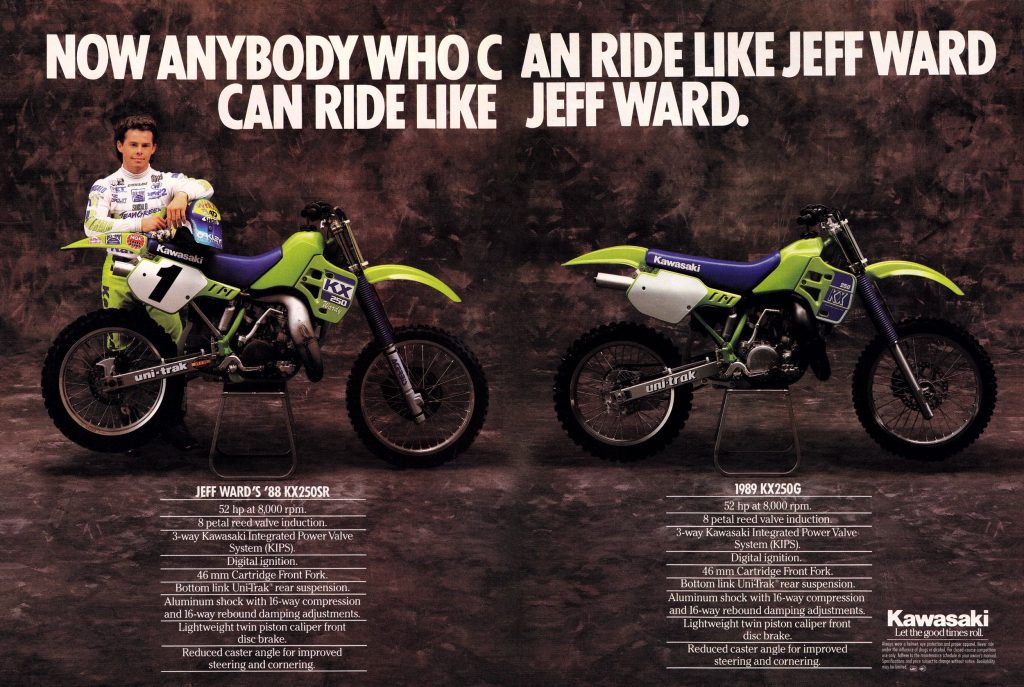 It is easy to see the differences in the new bodywork in this ad for the new KX250. The 1989 machine added a new, flatter, and firmer saddle and redesigned tank that reduced fuel capacity by 0.4 gallons. Photo Credit: Kawasaki
Initially, this had been Kawasaki’s plan as well, but during final testing, it seemed that Kawasaki’s US testers had not been happy with the performance of the 41mm inverted units. This led them to implore Kawasaki USA to hold off on the inverted forks and stick with conventional forks for one more year. At the time, this was a pretty risky move as most of the press had already shown the ’89 models with the expected inverted forks in their model previews. In addition, KXs not bound for the US were still set to get the UDS forks in ’89. With so much hype around the move to inverted forks, this move was a serious gamble for Kawasaki USA. It made their already stodgy-looking machine appear even more old-fashioned, and if they miscalculated, it could have been a real black eye for the testers and engineers who championed the change.
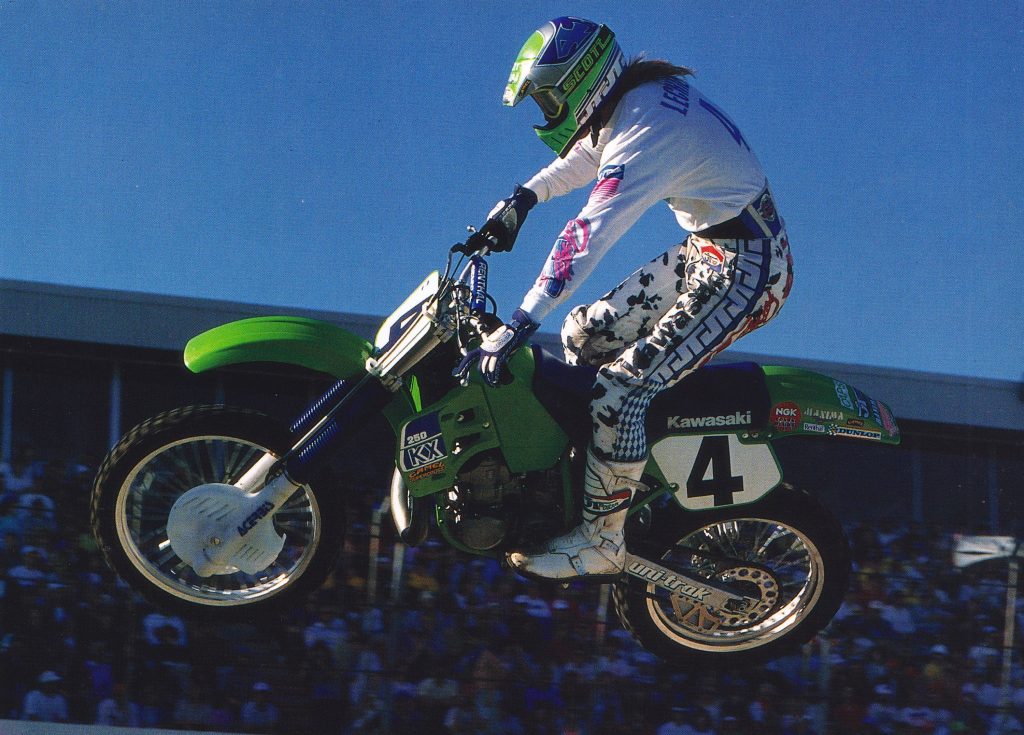 Ronnie Lechien joined Jeff Ward on the new KX250 in 1989. Ronnie enjoyed a solid season on the KX, taking the win at Pontiac and finishing the Supercross season in second place behind Honda’s Jeff Stanton. Photo Credit: Paul Buckley
While the 1989 KX’s conventional forks lacked a bit of the showroom cache of the inverted designs, they were far from outdated technology. Kawasaki knew they needed to improve the steering precision of the KX250 for ’89, so in addition to steepening the frame’s geometry, they also increased the diameter of the KX’s forks from 43mm to 46mm. This was a trick used by the factory team in 1988 to improve the rigidity of the front end while still allowing for sufficient compliance in the rough. The new 46mm conventional Kayaba cartridge forks were replicas of the works forks used by Ronnie Lechien and Jeff Ward in 1988 and were both stronger and lighter than the 43mm Kayaba units found on the ‘88 KX. The new forks pumped out 11.8 inches of overall travel and offered 16 selectable settings for compression control. Rebound damping was set at the factory and was not externally adjustable.
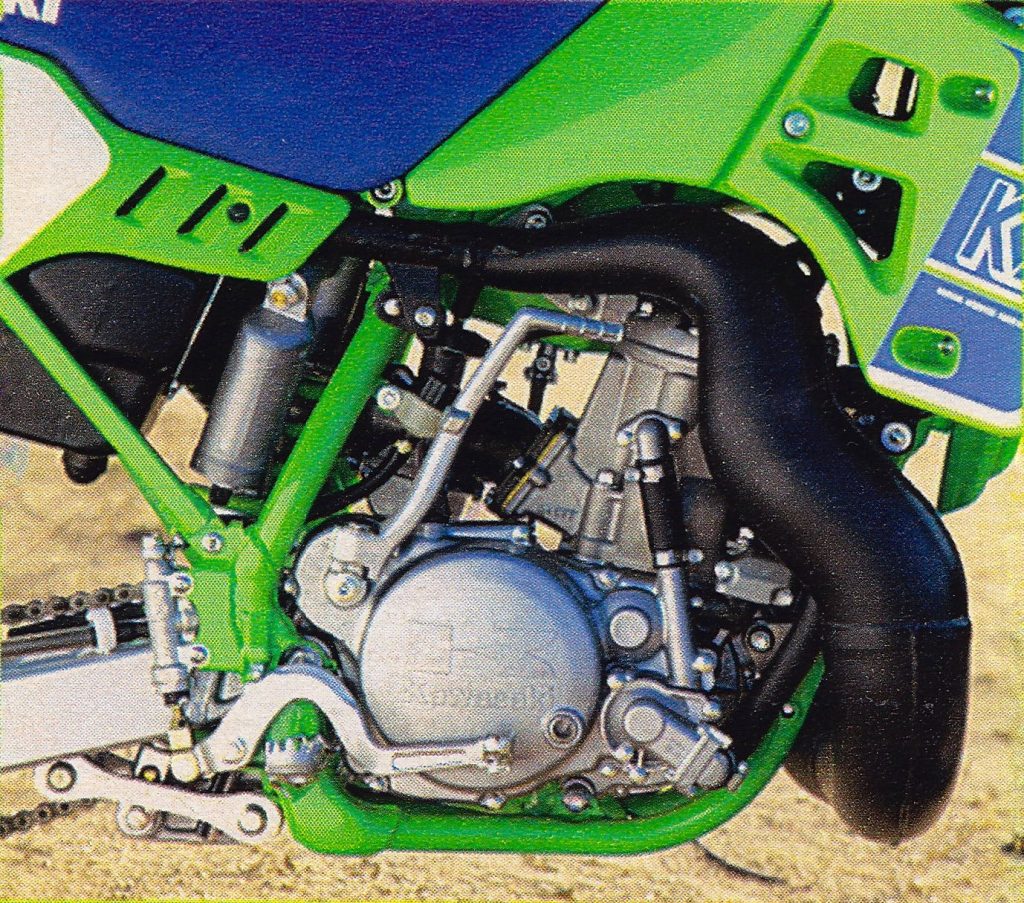 The motor changes for 1989 yielded mixed reviews from most testers at the time. The revised powerband pulled farther on top but delivered its power in a smooth and electric fashion that many riders found disappointing when compared to the blistering ’88 machine. Photo Credit: Kawasaki
In the rear, the Uni-Trak suspension was largely a carryover from the year before. The spring rate of the Kayaba damper was unchanged from the year before, but Kawasaki did update the valving for improved performance. The construction and rising rate ratio of the Uni-Trak linkage remained unchanged from 1988. Overall travel was set at 13 inches with 16 adjustments available for compression damping and rebound control.
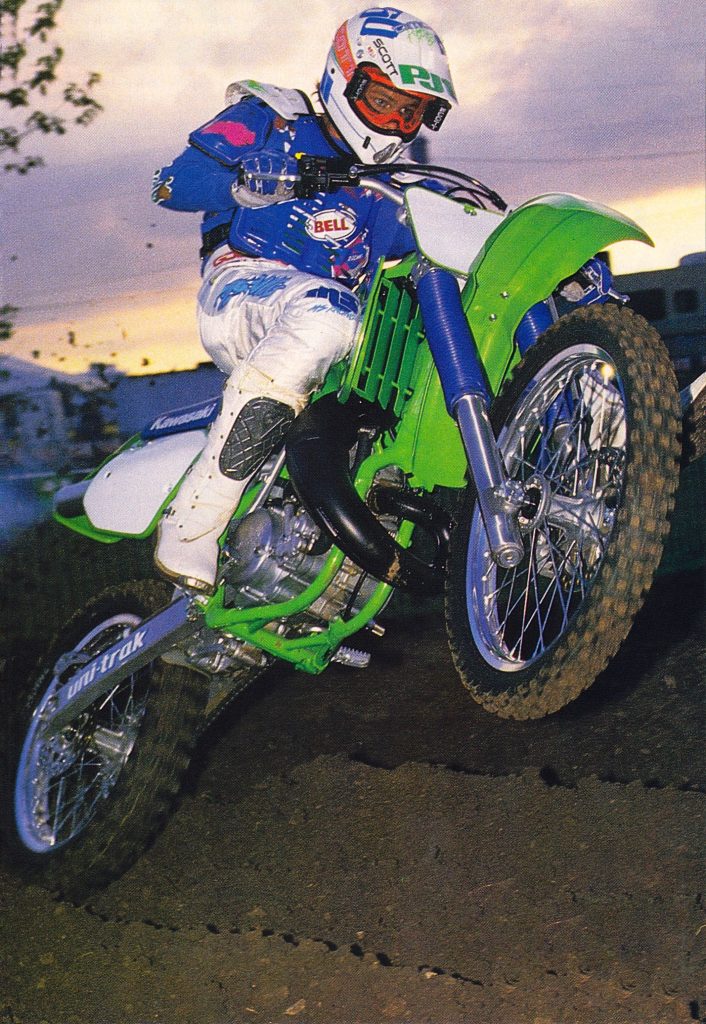 The 1989 KX250 was an excellent handler despite its Rubenesque layout. The bike felt a bit heavier than its more svelte rivals, but it turned well and was very stable at speed. Machines like Honda’s CR250R and Suzuki’s RM250 could cut underneath the KX if the track was ultra-tight, but no other machine in the class could match the KX’s overall handling excellence. Photo Credit: Dirt Rider
On the motor front, Kawasaki’s engineers went looking for usability more than power in 1989. They already had the fastest bike on the track, but even Jeff Ward was said to have preferred a bit less hit than the ’88 machine provided. The KX’s brutal punch could be a real handful if the track was slick, and finding a way to meter out that wallop was one of Kawasaki’s goals for 1989.
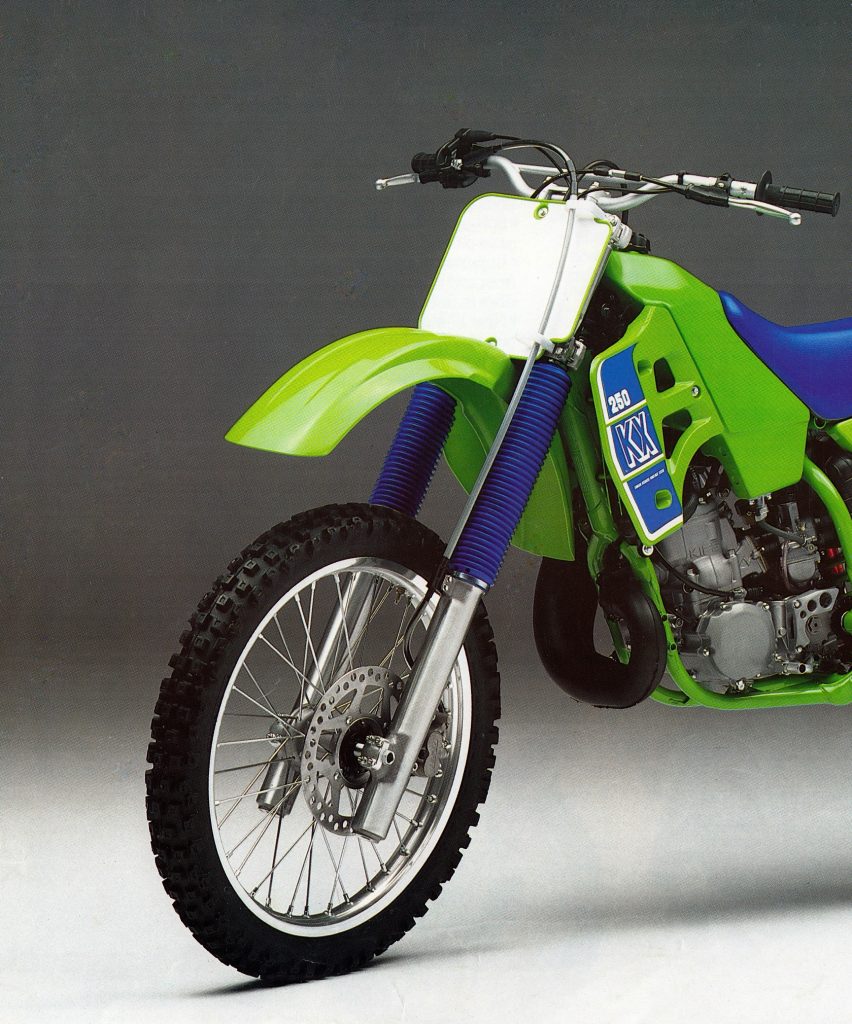 The KX’s new 46mm Kayaba conventional forks lacked the showroom appeal of the new inverted designs but made up for it with far superior performance. They were ultra plush in the rough while still offering excellent compliance on big hits. Photo Credit: Kawasaki
The bore, stroke, and basic configuration of the KX’s 249cc mill remained unchanged, but Kawasaki made several tweaks to the motor to smooth out the hit and broaden its overall power profile. First up was a new cylinder that reduced the height of the main exhaust port by one millimeter. This was matched with all-new settings for the Kawasaki Integrated Power-valve System (KIPS), designed to provide a smoother delivery and improved exhaust scavenging. An all-new digital ignition and a redesigned expansion chamber promised a longer pull on top, while a one-millimeter smaller 38mm Keihin crescent-slide carburetor looked to improve throttle response.
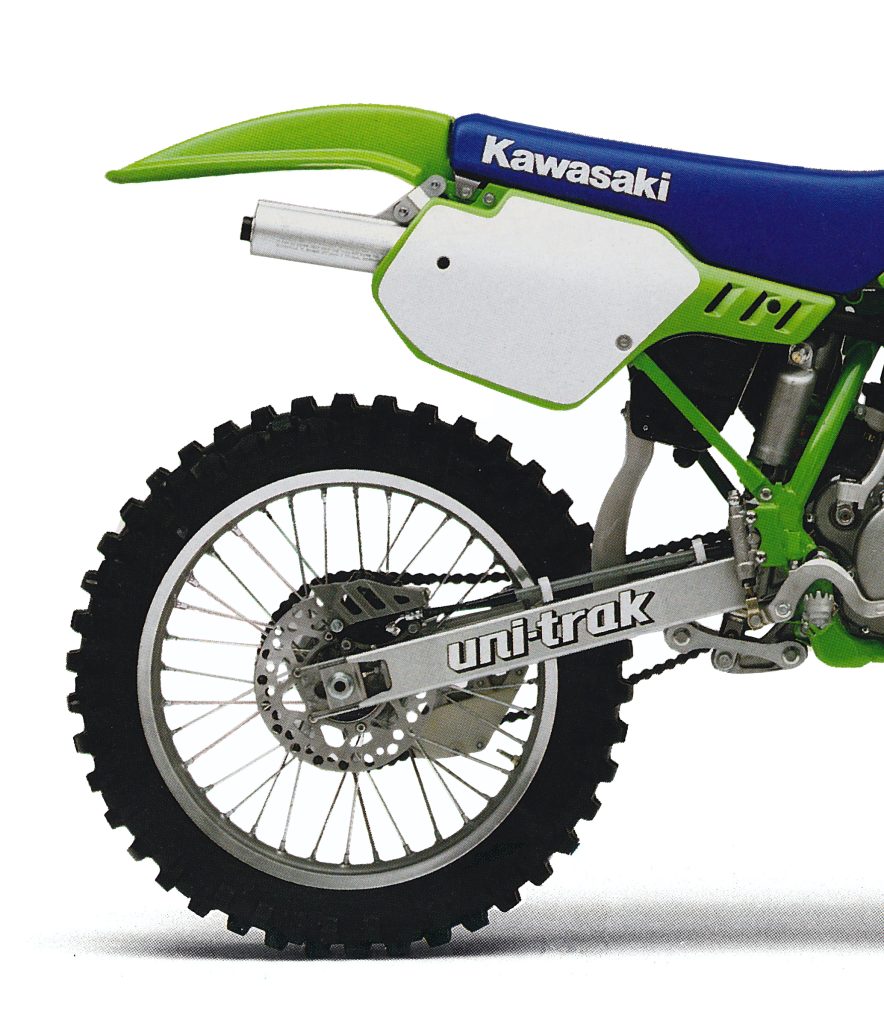 The KX’s Uni-Trak rear suspension was equally well sorted in 1989 and one of the machine’s greatest assets. Riders both fast and slow praised its controlled and compliant ride.
On the track, the revamped KX250 turned out to be a much-improved machine in nearly every respect. Most notable was the improved handling from its revised frame and beefy new forks. Previous KX250s had rarely won many accolades in the handling department, but the ’89 version turned out to be a real gem on the track. The steeper geometry, improved ergonomics, and sturdier front end turned a mediocre handler into the consensus pick for the best-handling machine in the class. It was much sharper in the turns than previous KXs while still retaining the stability riders appreciated the year before. It was not as quick to change direction as the hyper Honda and Suzuki, but neither did it shake its head like the front wheel was about to come off when coming down from speed. The front tracked straight and stuck to the track with an alacrity not seen on previous green machines.
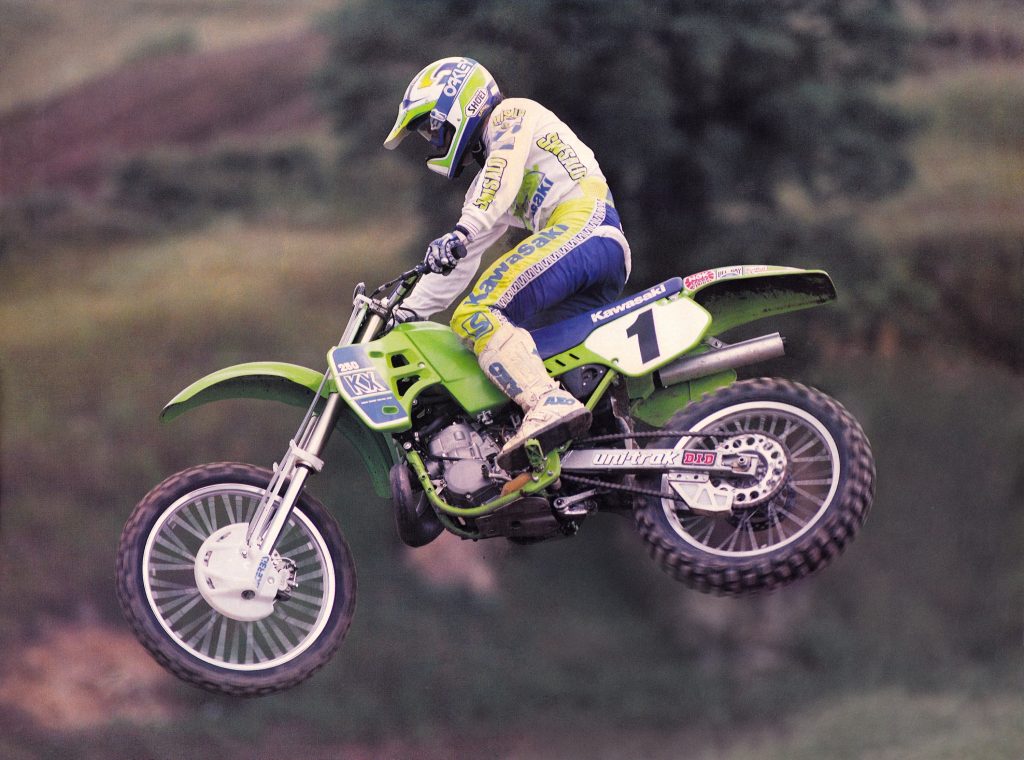 Jeff Ward had a solid outdoor season on the KX250 in 1989, but he was unable to back up his 1988 250 Motocross title. For Ward, revenge would have to wait for the 500 season, where he would become the first rider ever to claim a 125, 250, 500 Motocross, and 250 Supercross title. Photo Credit: Kinney Jones
About the only complaint riders seemed to have with the KX’s handling was its continued girthy feel. The new seat and tank were tremendous improvements, but the KX continued to feel twice as thick as Honda’s razor-thin CR250R. Whether in the air or on the ground, the KX felt noticeably heavier than its rivals. Taller riders seemed to have less of an issue with the KX’s chubby feel, but no one was going to mistake the big green machine for a svelte 125.
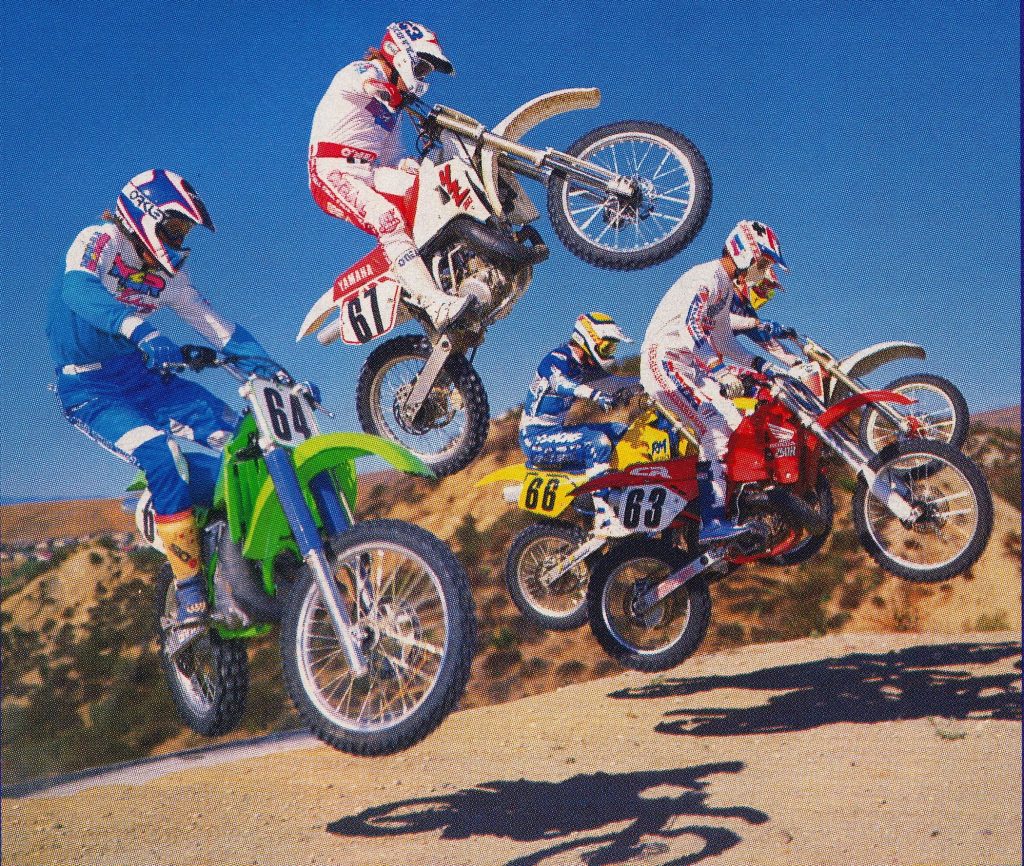 The 250 crop of 1989 was a solid group of motorcycles. Every machine had its virtues and could win with a bit of fine-tuning. Photo Credit: Dirt Bike
Next up on the win list for 1989 was the KX’s excellent stock suspension. The decision to stick with conventional forks may have cost Kawasaki some showroom cred, but it turned out to be a major coup for the KX’s riders. The 46mm Kayaba forks used settings developed by Jeff Ward during the 1988 250 Outdoor Motocross Nationals, and the result was the best set of forks ever to grace the front of a green machine. They were by far the best-sorted forks in the class and head and shoulders better than the inverted competition. The beefed-up sliders reduced flex while still providing the compliance that riders on the ultra-harsh new Hondas were sorely missing. They were super plush on small chop while still handling big hits with ease. Everyone, from novice to pro, raved about their action in 1989.
Out back, the changes were less dramatic, but the updated KYB damper did an equally excellent job of smoothing out the track. The rear tracked much more smoothly through the rough than in 1988 and delivered a super plush and well-controlled ride. Big hits and small bumps were all taken in stride by the KX’s excellent rear damper. Like the forks, it was the best rear suspension ever to grace a Kawasaki and the hands-down victor in the 1989 shock standings.
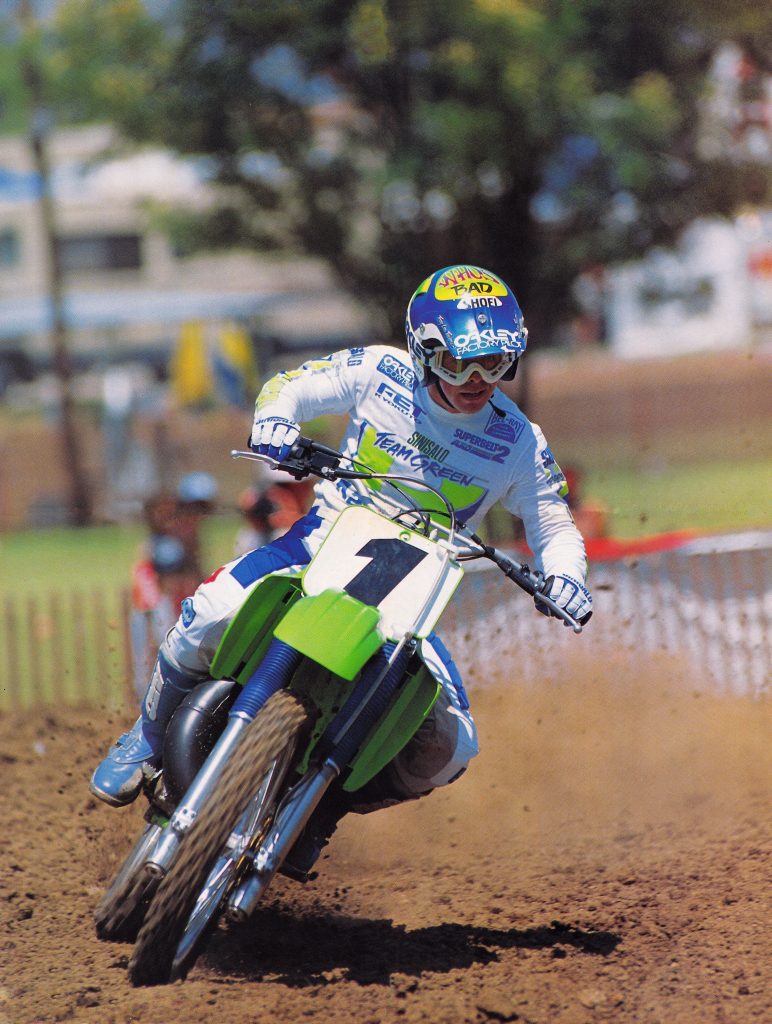 To the seat of the pants, the KX felt a bit slow in ‘89, but that was more an illusion than reality. Its motor pumped out the most peak power in the class, but it did it in a smooth and electric fashion. The KX was actually quite fast and more than capable of running with its rivals, but riders expecting the ’88 KX’s bark were often left somewhat disappointed. Photo Credit: Motocross Action
On the motor front, the KX got more mixed reviews than the rest of the machines in 1989. Kawasaki’s goal had been to broaden and smooth out the ’88 machine’s brutal delivery, and in that they were very successful. On the dyno, the KX pumped out 41.9hp, outpowering even Honda’s blisteringly fast CR250R. That was the highest output of any 250 in Dirt Rider’s shootout, but that impressive figure was somewhat misleading. On the track, the new motor actually felt significantly slower than the older KX mill. The revamped engine did away with the ’88 machine’s massive hit and delivered a far smoother experience. It was far less abrupt off the bottom and less explosive in the midrange. It pulled farther on top than the old engine, but many riders felt the updated power profile was a step down from the year before. The revamped mill was easier to ride but less exciting on the track. It was very similar to the conundrum Honda had faced the year before with the electric powerband on their 1988 CR250R. In any test of actual speed, both machines were very fast, but they did not feel that way to the rider. The ultra-smooth delivery was deceiving, and not everyone liked the change. It was not any real hindrance to the competitiveness of the machine, but many felt the motor was less fun to ride than the year before.
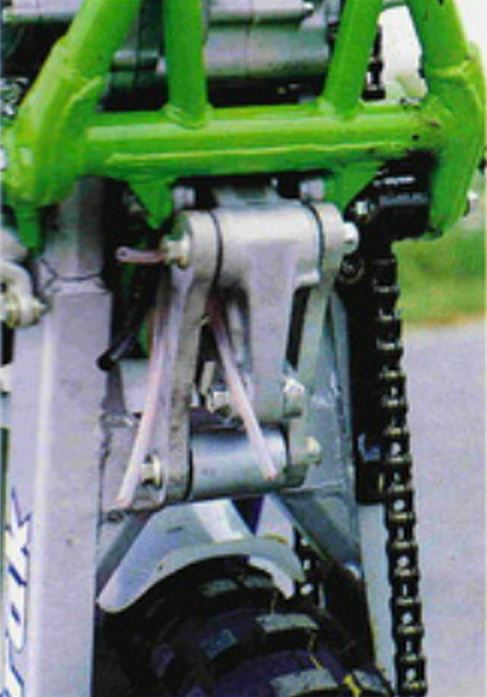 Kawasaki made some strides toward better quality in 1989, but frame breakages continued to be a concern. Keeping a close eye on the linkage mounts was advisable if you rode hard or put a lot of hours on your KX. Photo Credit: Kawasaki
On the detailing front, the KX was a well-appointed machine for the time. Its fully removable rear subframe made servicing the rear shock easy, and the trick closable shutters built into the airbox were a great feature if the track got muddy and you needed to close things up. The KX’s reversible bar mounts made it easier for tall guys to find extra room, and the one-piece bar clamps prevented the mounts from twisting in a crash. The bodywork was still a bit too bulky for many riders’ tastes, but the reformulated plastic was much less brittle than in the past. The new firmer seat was also a tremendous improvement over the buttocks-punishing Wonder Bread saddle of 1988. The two-piece removable clutch cover was a great time-saving feature that only Honda and Kawasaki offered in 1989. The new dual-piston front stopper was very powerful and no longer suffered from the drag that plagued the ’88 KX. The new 19” rear wheel was trick and helped the ultra-smooth motor hook up on slick dirt, but it did limit the available selection of tires in 1989. Last item on the thumbs up list for ’89 was the KX’s price, which at $3599 was the least expensive in the 250 division. That was $400 ($1100.00 in 2026 dollars) less than the $4000 Honda and a nice head start on some aftermarket upgrades for any KX pilot.
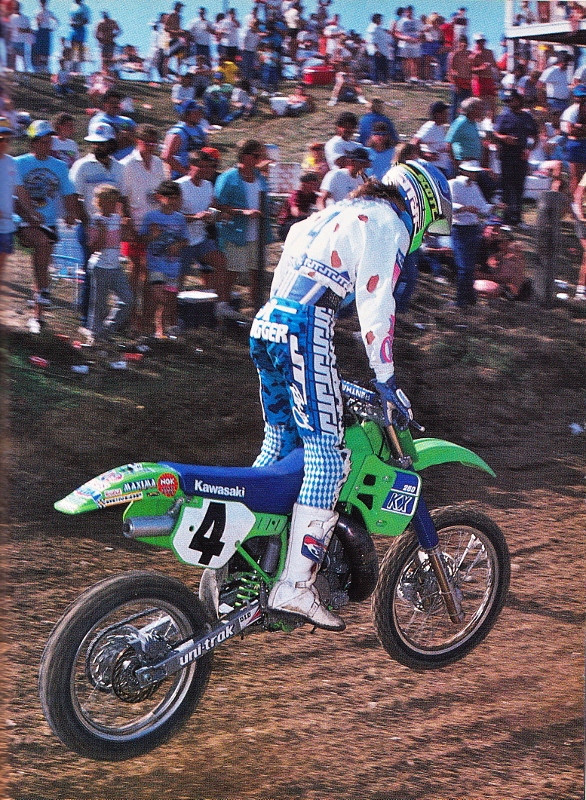 Ron Lechien finished in third overall, right behind his teammate Jeff Ward in the ’89 250 National Motocross standings, but the season would be his last on the factory team. A broken femur at Steel City would end his season and signal the end of his affiliation with the Kawasaki factory team. Photo Credit: Motocross Action
On thumbs down list for ’89 were the KX’s continued issues with frame failures. Hard ridden KX’s were commonly known to suffer cracks and breaks at the welds, and it was critical to carefully inspect the linkage mounts when servicing the Uni-Trak. If left unattended, you might find yourself with a very costly hospital and repair bill. The ultra-powerful brakes turned out to be a bit of a double-edged sword, with many riders finding their sudden engagement difficult to modulate. The front disc was works-bike strong and the rear was very easy to lock up unintentionally. It took a while to get used to their power, and most riders preferred the equally powerful but not nearly as touchy brakes found on the CR. The motor was powerful and largely reliable, but it was a good idea to swap out the stock carbon fiber reeds for an aftermarket alternative before the stockers chipped or broke. The stock steel bars, chain, and sprockets were of unimpressive quality, but this was par for the course from Japan in 1989. Going aftermarket here was a must if you took your racing seriously.
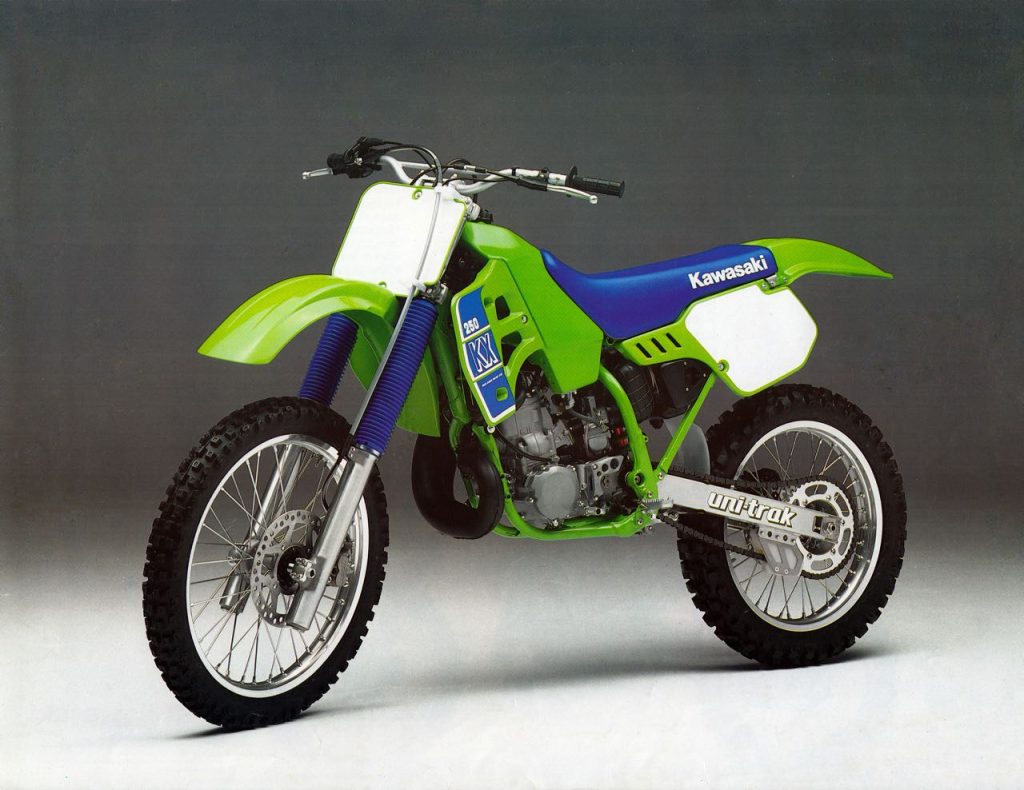 In 1989, Kawasaki took several gambles with their KX250, and not all of them paid off. The chassis and suspension changes were big hits, but the mellow motor was far more controversial. Photo Credit: Kawasaki
Overall, the 1989 Kawasaki KX250 turned out to be a very competitive racer. It offered the best handling and suspension in the class and the highest peak horsepower numbers of any machine in the 250 division. The new, smaller tank and firmer saddle were huge improvements, and frame changes yielded an excellent combination of confidence and control. The motor changes for 1989 were not nearly as popular, but the bike remained a winner despite its smoother delivery. The 1988 KX250 was a fun machine to ride, but as a racer, the ‘89 version was a far better machine in nearly every way and one of the best 250s of 1989.