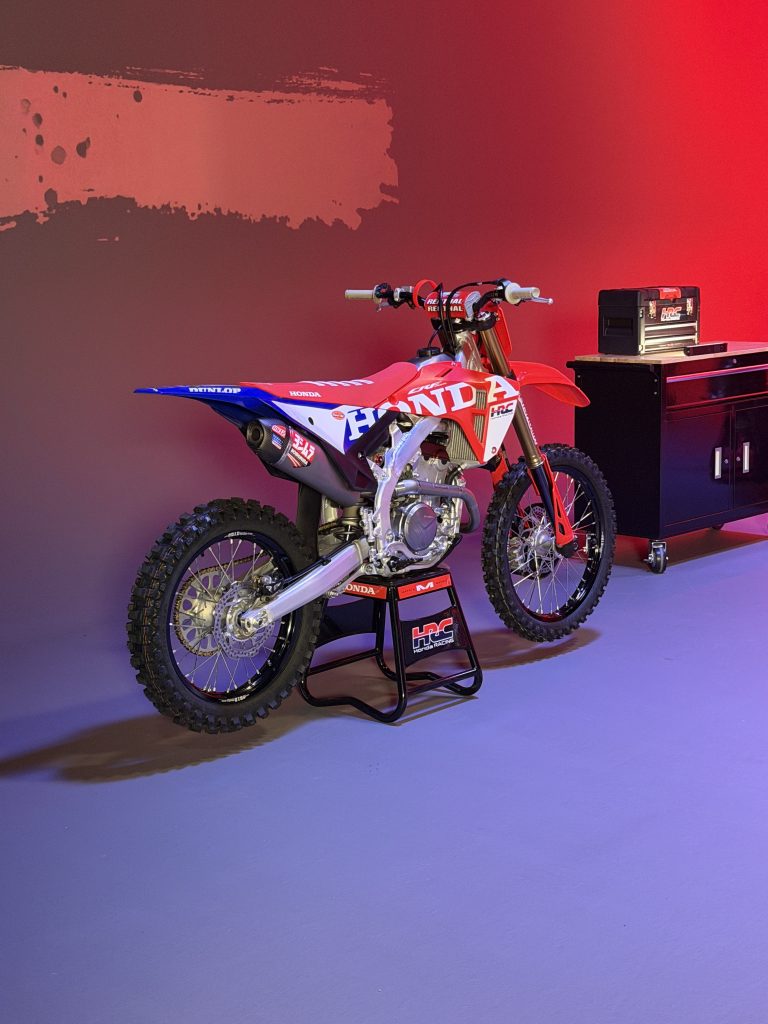
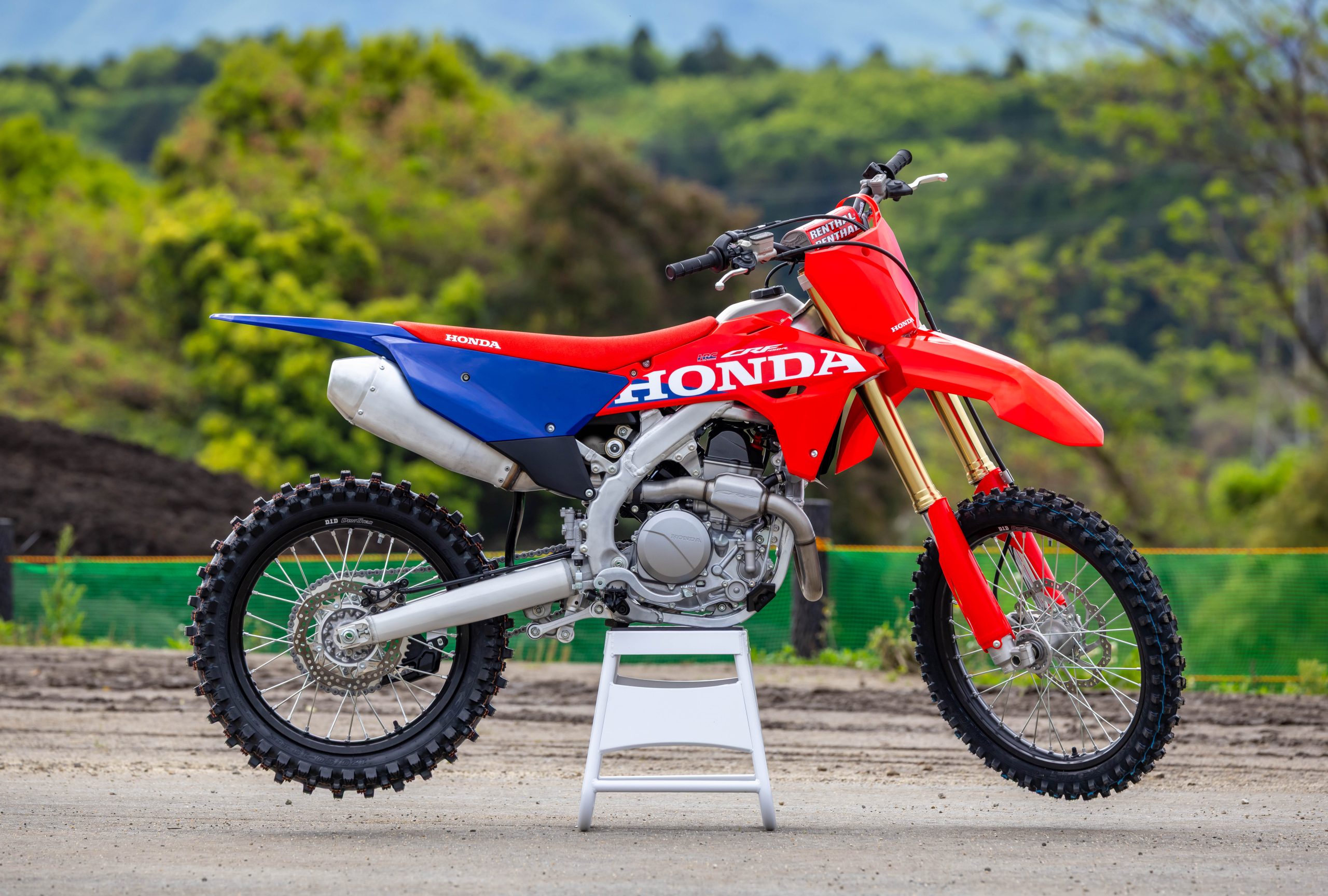
What Is New For 2027:
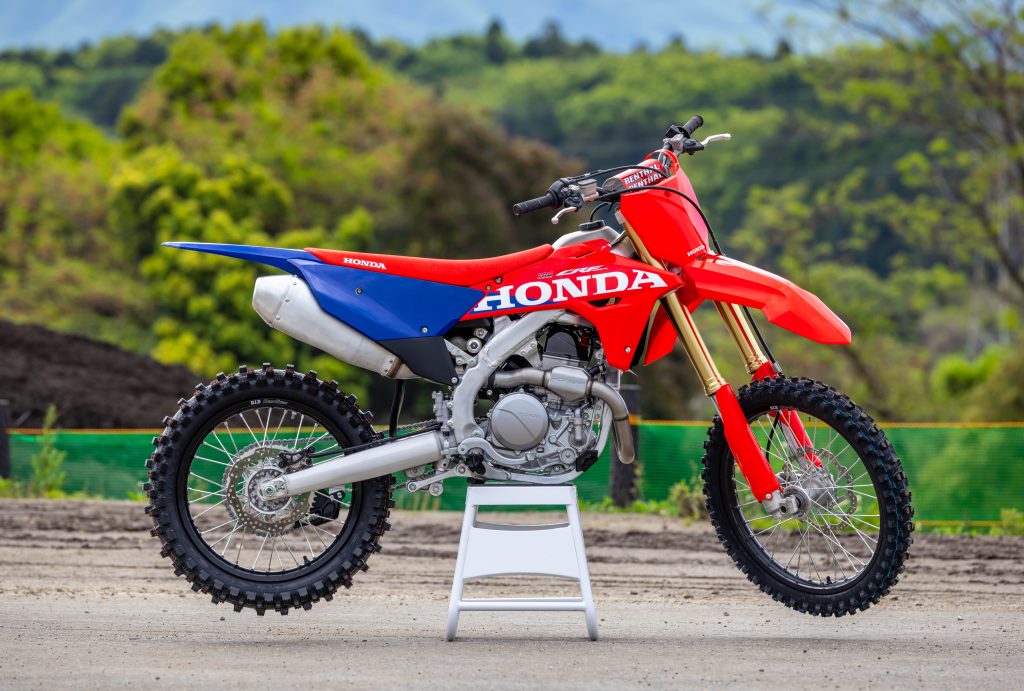
• 9.9-pound weight reduction. Curb weight is 238.1 lbs. Weight without fuel
is 226.4
• Revised base geometry & rider position. Wheelbase is now 58.7 inches—
0.3 inches longer than before—and the rear axle is moved upward by 0.5
inches. Rake is increased by 0.2o, to 27.5o.
• Brand-new, 6 lbs.-lighter engine with more power across the rev range
and 17mm narrower width. Maximum output is 10.3% higher, while
maximum torque is 3.7% higher.
• New bodywork, matching works bikes used by the Honda HRC Petronas
MXGP team.
- New tricolor livery unifies the Honda Racing image/brand.
- New larger-capacity titanium fuel tank (1.7 > 1.9 gallons).
• Sustainable materials used for some parts, including front fender, front
number plate, side panels and seat base.
• New engine with more rigid crankshaft assembly, new bearings. Crank
web was changed from anchor profile to round.
- Bore and Stoke changed from 96.0 x 62.1 to 97.0 x 60.83.
• Optimized shape of combustion chamber and piston crown. Compression
ratio is 13.75:1.
• Full transistorized ignition and ignition coil, with updated fuel-injection and
ignition settings.
• New airbox, air filter, air funnel. The intake path was redesigned for
straighter airflow, while air cleaner box was newly designed with a rear
duct. Air cleaner lid was eliminated.
- Evolved Unicam valvetrain system that is lighter and more compact.
• Larger intake and exhaust valves, more aggressive cam profile, switch to
titanium exhaust valves.
- Steeper angle for all valves, and shorter/steeper downdraft intake.
- New clutch with lighter design and innovative back-torque-limiter design.
• Redesigned transmission is smaller and lighter, and has revised, taller
gear ratios.
- Redesigned lighter, more-reliable starter system.
• New exhaust system, designed to meet AMA sound limits. System
includes a 3.4-inch longer header and 3.0-inch longer muffler.
• New main wiring harness.
• New design for main frame and rear subframe. About 70% of the main
frame’s components are new, while longitudinal and torsional rigidity is
increased about 10%, without increasing weight.
• New swingarm, chain slider and plastic chain-guide plate. Swingarm is
roughly 1.1 lbs. Lighter and has D-shaped cross section.
Suspension has changed internals/oil/setting, with extensive steps taken
to optimize damping feel and consistency, including between front and
rear.
• Fork switches from the traditional Bending Control Valve configuration to a
Dynamic Blow System main-piston-valve structure, for improved stroke
consistency.
- Kashima coating added on internal suspension parts, front and rear.
• Stiffer front suspension springs. Fork spring rate was increased from
5.0N/mm to 5.2N/mm.
- New shock linkage with revised ratio and a new thrust needle bearing.
- New rear-wheel hub design.
- Dunlop MX34 tires front and rear (rear with a new size 120/90-19).
So What Do These Specs Mean To You?
Although I didn’t get to go on the Japan trip, I did get a chance to head down to the Honda main office in Torrance, California to go over the new CRF450R with Trey Canard and Lars Lindstrom. What I gathered from talking to them both is that this 2027 CRF450R has been a group effort between the production test team, Team HRC Honda and the MXGP HRC team. A lot of what racing has learned has been brought over to the production side more than ever before.
Chassis:
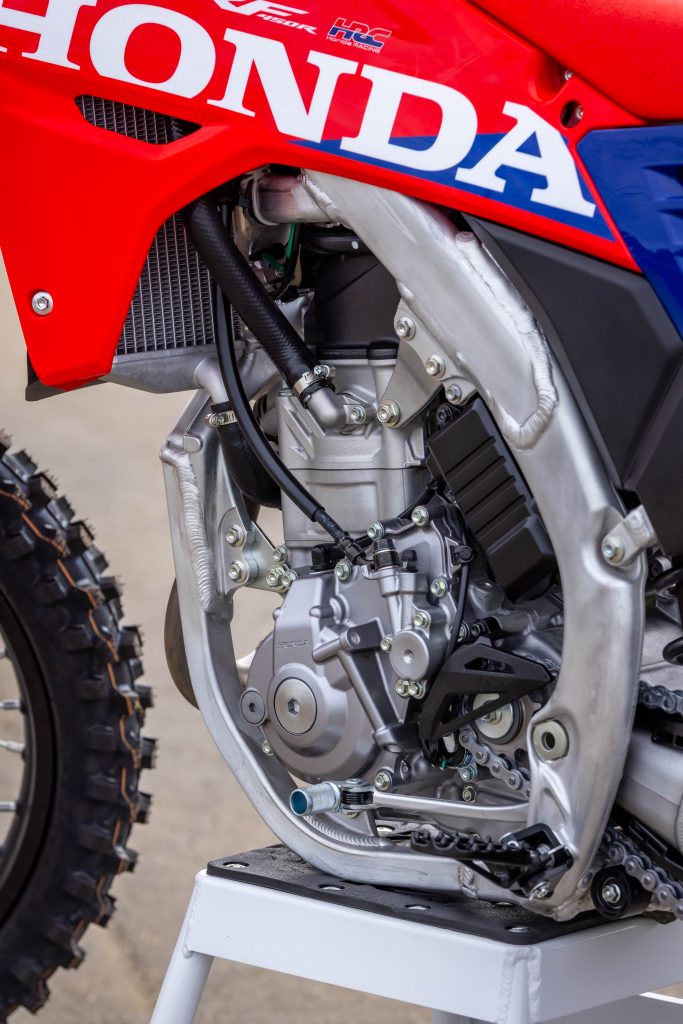
If there was one thing that I would want improved on the Honda CRF450R, it would be a more stable/compliant chassis feel. I feel like Honda has a great engine package with the current CRF450R, but the chassis just feels rigid/stiff when the track gets edgy or rough. The 27′ chassis got increased stiffness in key areas near the headtube/downtube areas (which can help with plushness feel on the track) just like the 2025 bike did. Don’t let the term “increased rigidity balance” or “longitudinal and torsional rigidity is increased” fool you when Honda’s marketing team starts talking those terms. Increased rigidity balance in some cases can help make us riders feel more comfort within the chassis when on the track so to me, I feel like this is a good direction for the brand. Mimicking the direction of the factory race team, the footpegs were repositioned 5mm rearward, moving rider weight to the rear of the bike and the rear axle is moved upward by 0.5 inches.
The overall wheelbase is longer as well as the rake and trail of the CRF450R have increased by 0.2º, to 27.5º.. This is also great news. How many of you have ridden other brands of bikes and then hopped back on your CRF450R and felt like the bike was short or felt like the front wheel was tucked in more towards the cockpit than other colored machines. The Honda needs more length to be more planted out on the track and the 2027 is just that. LONGER! Now if you’re freaking out because you loved the way your CRF450R cornered and you think going longer could hurt your cornering, you could be right. But… Yes, there is a but… I have been a part of several tests where I have made the bike longer in wheelbase and also increased the rake of the bike to find out that I had more cornering stability, not to mention more consistent lean angle throughout the corner. I am not predicting the future here but again, what Honda is doing with these numbers is a good thing for any rider who wants a more stable red/blue machine.
Engine:
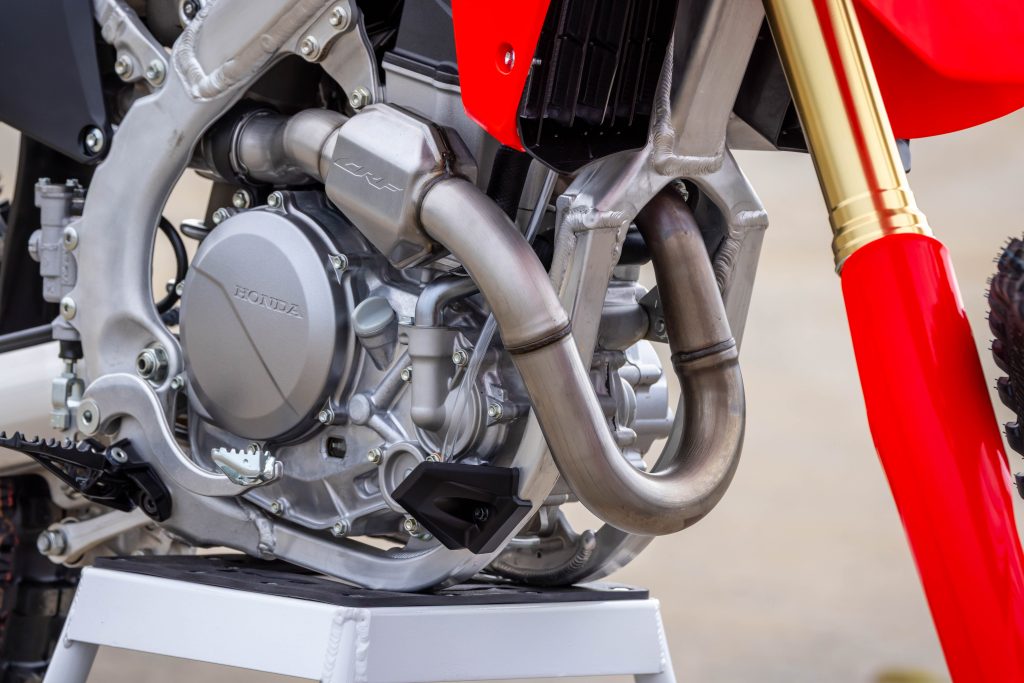
A higher compression piston, a more rigid crankshaft design, as well as updated bearings on the crank along with a straighter air intake system means more power but hopefully a more linear Jett Lawrence type bike power. Larger intake and exhaust valves, more aggressive cam profile, and a switch to titanium exhaust valves also means that Honda is looking for more torque as well as freer type of rev (AKAK, excitement). A lot of media test riders get consumed by perception of power by how quick the bike can “hit” or another words, how much low end excitement it has. Honda was tired of hearing their bike “felt slow” by some test riders (not me by the way) so doing some of these changes assures the Honda gets some more excitement but could be tamed with ECU settings to control that newfound low end/torque feel. When I rode Jett’s factory bike I couldn’t believe how easy it was to ride without it yanking my arms out or vibrating my hands off the Renthal 839 Fatbar.
The engine itself to the naked eye looks more compact, the clutch is smaller in diameter and is similar to a slipper style clutch system. The basket diameter was reduced by 7mm, to 132mm, and the primary driven gear has a lighter, ring-type design, eliminating the center portion of the previous version. The new clutch also features a unique rubber-damper-activated back-torque-limiter system, similar to a cush drive in a rear-wheel hub. In addition to the rubber damper’s conventional function of absorbing and mitigating torque fluctuations, it takes on an additional role with this new design; now, the damper also adjusts clutch capacity by deforming when back torque is generated. This provides a slipper function.
Making the engine (parts) more compact is one of the big way to drop weight but it also reduces drag on the engine which can help with power feel. If you have never rode with a slipper clutch, it is one of the best a creating a lightweight feel off throttle (hardly no engine braking) so I am excited to see what the Honda clutch engineers came up with. We also heard that Jeffrey Herlings and Tom Vialle have been using this exact “stock” clutch in their race machines back in Europe.
Another small but important piece to keep the updated CRF450R engine running is fuel capacity right? Lars told me that their factory fuel tanks are larger for outdoor motocross in order to complete 30 plus 2, so in 2027, Honda went from 1.7 gallons to 1.9 to ensure the bike can go at least 35 minutes in deep dirt/sand conditions. I have ran out of fuel in a sand moto on our CRF450R at 34 minutes so this is a good thing!
Transmission:
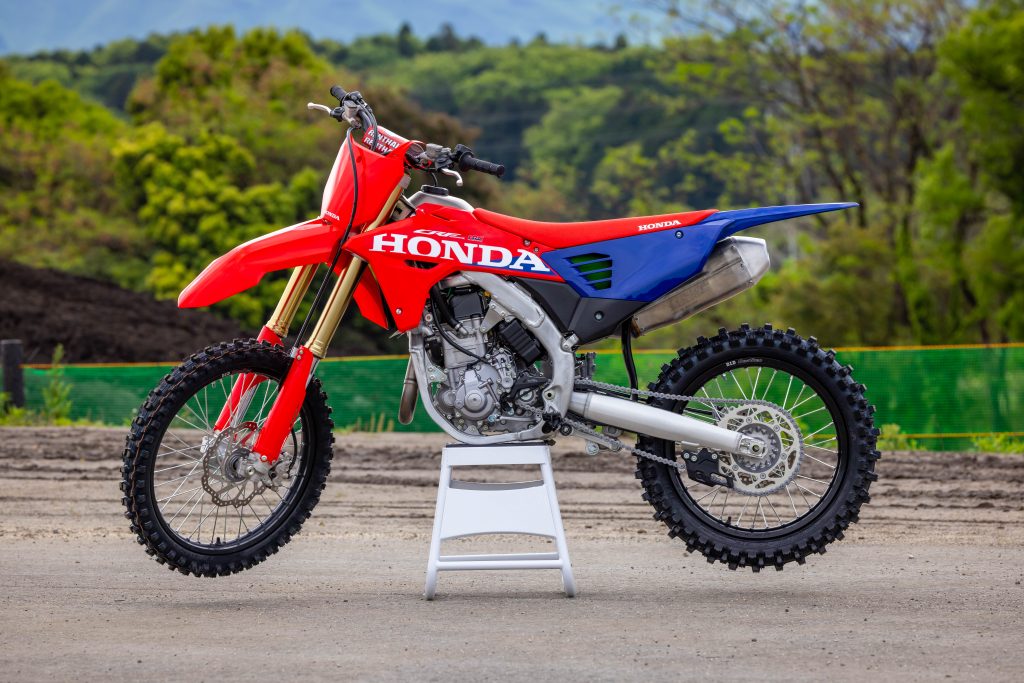
To match the significant increase in engine power, the transmission’s gear ratios were reoptimized. Compared to before, all five gears are talle. First gear is 18.173 (versus 18.954 before), second is 14.908 (vs. 15.156), third is 12.554 (vs. 12.626), fourth is 10.741 (vs. 10.755) and fifth is 8.889 (vs. 9.271). With the new ratios, the engine works across a wider speed range, requiring fewer gear changes.
At the same time, the number of lead grooves on the transmission’s shift drum were reduced from three to two, by combining the lead grooves for the right shift fork and the center shift fork. What this does is basically allows the width of the shift drum to be reduced by 13.4mm, to 63.5mm from 76.9mm. The drum is also now constructed of a high-strength material, enabling further wall-thinning and contributing to an additional weight reduction of 0.3 pounds (46%).
In addition, engineers changed the transmission’s main-shaft bearing from an annular-collar design to a split, resin-cage needle-bearing design, a change that subsequently enabled reductions in the size and weight of other transmission components. The new transmission has a 14mm shorter main-shaft length, and it weighs 1.1 pounds less than its predecessor (a 15% reduction).
Fork:
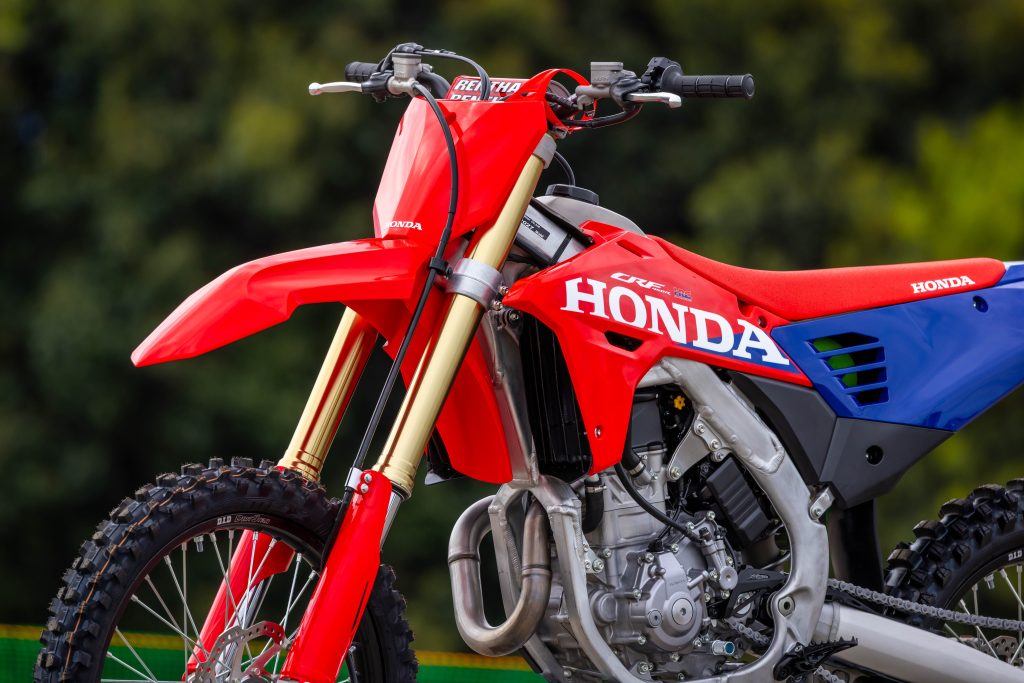
Showa has a new Dynamic Blow System main-piston valve structure replaces the traditional Bending Check Valve structure. Additionally, the rate of the main spring was increased from 5.0 N/mm to 5.2 N/mm.
A Kashima coating was applied to internal sliding components like the rod and cylinder, and the hole in the main piston rod is now smaller, increasing extremely low-speed damping force.
The combined result of these changes is improved stroke consistency and better damping feel, with increased compression damping in the extremely low-to low-speed range.
An updated seal between the steering stem and the top triple clamp delivers optimized friction characteristics during steering inputs, for enhanced chassis stability.
Shock:
Even the subframe is shaped a little different (as the older subframe will still mount up), your old shock will fit on the newer Honda so don’t fret. The Pro-Link rear-suspension system is highlighted by a Showa shock absorber with a 50mm body. Some internal sections of the reservoir body were machined, resulting in a thinner wall and reducing weight by 1.4 ounces.
As with the fork, compression and rebound damping have been increased, and the main piston band was optimized to permit freer piston movement. This reduces the difference between static and dynamic friction, improving consistency.
The coil spring within the shock’s compression damping-force adjuster has a much stiffer rate (87.4 N/mm instead of 7.85 N/mm), enhancing damping feel in the low-speed-compression range and improving overall consistency. In addition, the spring guide has been redesigned to optimize adjustment sensitivity, and SS37 suspension oil is used (replacing SS25), matching the fork’s fluid for a consistent damping feel between front and rear.
Following the direction of the race team, the shock’s bladder was changed to a more-responsive round type, resulting in improved plushness and consistency. The bump rubber is now smaller, improving bottoming feel. Also consistent with Honda’s factory race teams, the collar and dust seal housing the spherical bearing within the upper shock mount has been updated to reduce shock play. This is said to help with moderating initial impact harshness. No more GHB? We will see..
In another move influenced by the factory HRC teams, the linkage ratio has been changed and a thrust needle-bearing construction has been adopted for the link (replacing the previous thrust washer), in order to try and reduce friction for better smoothness and traction feel.
Thoughts:
At the end of the day, it looks like Honda went ALL IN on changing the way we think when it comes to the handing of the CRF450R. Imagine a world where you have a Honda that is stable, that still corners well and is fast enough, yet smooth enough to ride hard for longer periods of time. We might be back to 2008, people! Only time will tell however and until then we can drool/hope all of these changes and specs are what we “hope” they will be out on the track. The new 2027 Honda CRF450R should arrive in late September and will run 10,099 MSRP. Yes, there is a HRC Works Edition as well (shown below) with the same updates and usual “WE” updates from the standard “R” model. that MSRP has not been set yet.